Corner Analysis
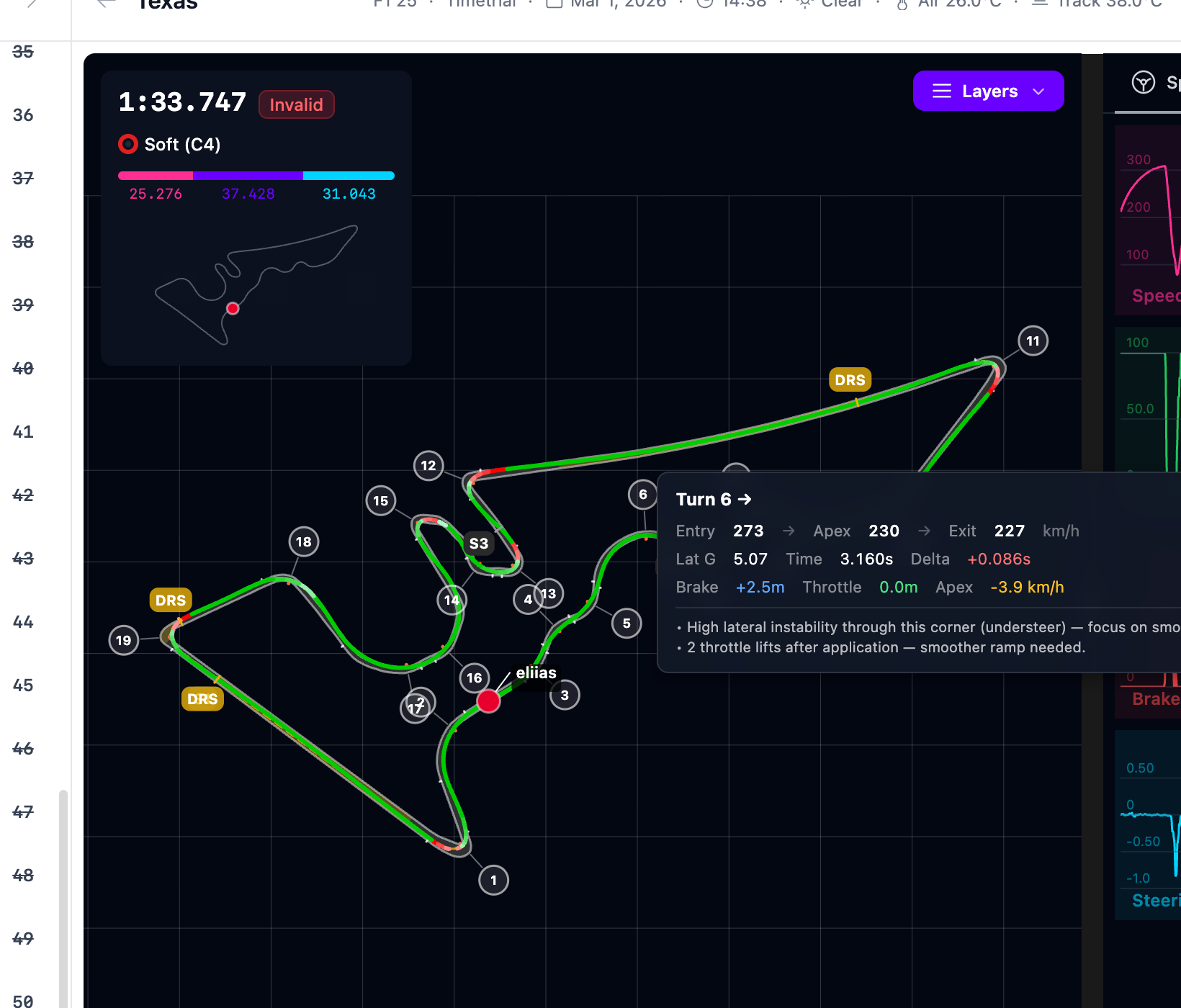
Corner analysis breaks down your performance at every turn using eight factors derived from your telemetry. Each factor compares your driving to a reference baseline, giving specific, measurable feedback on where time is gained or lost.
How It Works
At each corner, your telemetry is split into phases — braking, entry, apex, exit — and compared against a reference lap. Every factor is computed as your value minus the reference value, so zero means you matched the reference exactly.
Baseline Selection
The reference lap is selected automatically:
- Cross-user pool — All valid laps with telemetry on the same game, track, and configuration are considered, regardless of who drove them
- 90th percentile — The lap faster than 90% of all laps in the pool is selected. This gives an aspirational but achievable target
- Car filtering — Games with diverse car classes (iRacing, LMU, AMS2) filter by car class for fair comparison. F1 games skip car filtering since all cars have near-identical performance
- Fallback — If no cross-user laps exist, your personal best on the same game and track is used
The Eight Factors
1. Brake Point Error
| Unit | Positive Value | Negative Value |
|---|---|---|
| meters | Braked later than reference | Braked earlier than reference |
Measures the distance difference between where you first hit the brake (>5% pedal input) and where the reference did. A positive value means you carried more speed before braking. Late braking gains time on the straight, but only helps if you can still slow the car enough for the corner.
2. Peak Brake Mismatch
| Unit | Positive Value | Negative Value |
|---|---|---|
| ratio (0–1) | Braked harder than reference | Braked softer than reference |
Compares maximum brake pedal input. If the reference hits 0.95 and you hit 0.80, the value is -0.15. Under-braking often signals a lack of confidence. Over-braking can indicate late braking or lock-up risk.
3. Trail Braking Mismatch
| Unit | Positive Value | Negative Value |
|---|---|---|
| slope (brake/meter) | Releasing brake slower (more trail braking) | Releasing brake faster (less trail braking) |
Measures the slope of brake release from corner entry to apex. Trail braking — gradually releasing the brake as you turn in — loads the front tires for rotation. A negative value means you're releasing the brake too abruptly, losing front-end grip at turn-in.
See Reading Brake Input for detailed trail braking interpretation.
4. Entry Rotation Deficit
| Unit | Positive Value | Negative Value |
|---|---|---|
| g (lateral) | More lateral g than reference | Less lateral g than reference |
Average absolute lateral g-force between the entry point and apex, compared to the reference. Less rotation means you're understeering or not committing to the corner entry. More rotation could mean sharper turn-in or a tighter line.
5. Min Speed Deficit
| Unit | Positive Value | Negative Value |
|---|---|---|
| km/h | Faster apex speed than reference | Slower apex speed than reference |
The difference in minimum speed through the corner. Carrying more speed at the apex is not always better — overshooting the apex speed often costs more on exit than it gains on entry. Read this alongside Exit Traction Deficit to see the full picture.
6. Line Deviation
| Unit | Positive Value | Negative Value |
|---|---|---|
| meters | Always ≥ 0 | N/A |
Maximum distance between your world position and the reference position through the corner. Unlike other factors, this is always non-negative — it tells you how far your line deviates, not which direction. Requires world position data; confidence drops to 0.0 when positions are unavailable.
7. Throttle Pickup Delay
| Unit | Positive Value | Negative Value |
|---|---|---|
| meters | Got on throttle later than reference | Got on throttle earlier than reference |
The distance difference between where you first applied meaningful throttle (>20% input) and where the reference did. A positive value means you waited longer before getting on the power. Early throttle pickup is one of the biggest time gains on corner exit — but only if traction allows it.
See Reading Throttle Input for throttle pattern analysis.
8. Exit Traction Deficit
| Unit | Positive Value | Negative Value |
|---|---|---|
| g (longitudinal) | Better acceleration than reference | Worse acceleration than reference |
Average longitudinal g-force from apex to corner exit compared to the reference. Negative values mean you're accelerating less effectively — usually from wheelspin, poor line, or late throttle application. This factor directly impacts speed down the following straight.
Confidence Scores
Each factor carries a confidence value between 0.0 and 1.0:
- 1.0 — Full confidence in the measurement
- 0.5–0.9 — Partial data available, interpret with caution
- 0.0 — Data was insufficient (e.g., no world position for Line Deviation, no brake application detected, fewer than 2 telemetry samples in the corner zone)
Factors with 0.0 confidence are greyed out in the UI. Focus your attention on high-confidence factors.
Interpreting the Data
Reading a Single Corner
Look at all eight factors together to understand the full story. For example:
- Positive Brake Point Error + Negative Exit Traction Deficit = you braked too late and compromised the exit. The time gained on the straight was lost and more getting out of the corner.
- Negative Trail Braking Mismatch + Negative Entry Rotation Deficit = you released the brake too quickly at turn-in, which took load off the front tires and caused understeer.
- Negative Throttle Pickup Delay + Negative Exit Traction Deficit = you got on throttle early but had wheelspin, so the acceleration was poor despite the early application.
Finding the Biggest Gains
Sort corners by the magnitude of each factor to find where the most time is available. A corner with -3 km/h Min Speed Deficit combined with +15m Throttle Pickup Delay is costing you significant time and is a clear practice target.
Corner-to-Corner Patterns
If the same factor is weak across many corners (e.g., Trail Braking Mismatch is consistently negative), it points to a technique issue rather than a corner-specific problem. Focus on the technique itself rather than individual corners.
See also: Reading Brake Input for braking technique, Reading Throttle Input for exit analysis, Glossary for terminology