Reading Telemetry
Telemetry is a graph of what happened. Every input you made, every response from the car, recorded and plotted so you can see exactly where time was gained or lost. This guide teaches you to read it.
The Three Fundamental Traces
The single most useful telemetry view is speed, throttle, and brake plotted against distance around the lap.
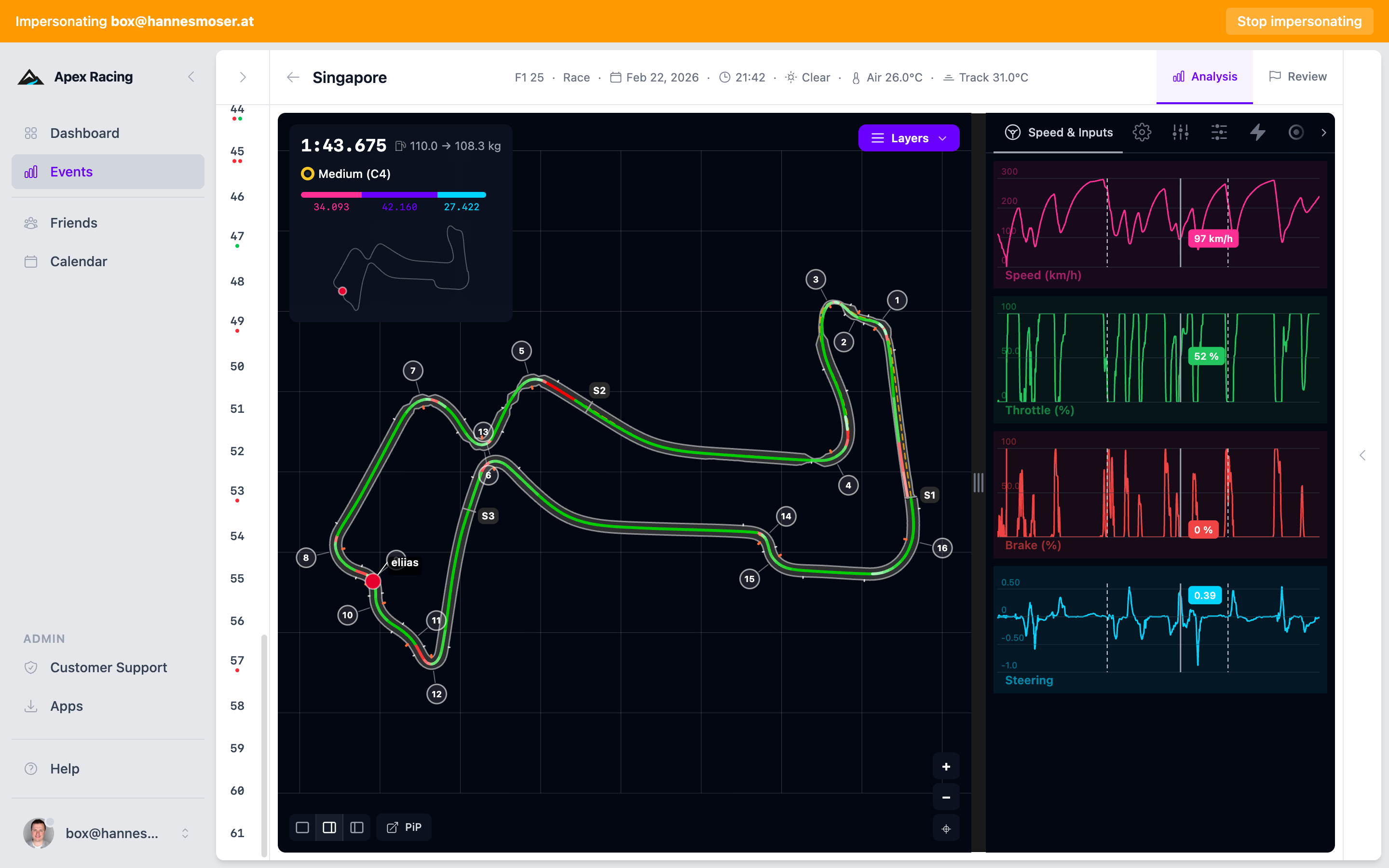
This one view tells you roughly 80% of what you need to know about a lap. Speed shows the result — how fast the car actually went. Throttle and brake show the cause — what you did with your feet to produce that speed. Distance on the horizontal axis (rather than time) makes it easy to compare laps even when one is faster than the other, because the same corner always appears at the same position.
Reading the Speed Trace
The shape of the speed trace through a corner tells you what kind of corner it is and how well you drove it.
Corner Shapes
- V-corner (hairpin) — sharp deceleration followed by sharp acceleration. The trace dips to a narrow point and recovers quickly. These are low-speed corners where you brake hard, rotate the car, and get back on the power.
- U-corner (long constant-radius) — gradual entry, a sustained period at low speed, then gradual exit. The trace has a wide, flat bottom. You spend real time at minimum speed, so carrying even 2-3 km/h more through the middle saves significant time.
- Flat-bottom (chicane) — a quick dip with almost no time spent at minimum speed. The trace barely touches the bottom before climbing again. These are rhythm sections where flow matters more than outright minimum speed.
Straights
Two things matter on a straight:
- Peak speed — determined mostly by your car's power and aerodynamic setup. If your peak speed is consistently lower than a reference lap, look at your wing levels or engine mode.
- Time to reach peak speed — determined by how well you exited the previous corner. A faster exit speed means the car reaches top speed sooner, and you spend more of the straight at maximum velocity.
Minimum Speeds
The lowest point of the speed trace in each corner is one of the most revealing numbers in telemetry.
- Too low — you over-slowed the car. The brake trace will usually confirm it: either braking too early, too hard, or too long.
- Too high — you carried too much speed and likely ran wide on exit, or the car understeered and scrubbed speed through the corner instead of at a single point.
- Just right — minimum speed matches the reference, and the exit speed builds cleanly from there.
Common Patterns
Learning to recognize these patterns will accelerate your improvement.
Late Brake, Slow Exit
The brake trace starts later than the reference, but the speed trace shows a deeper V-shape with a slow, hesitant recovery. You braked later but had to slow down more to make the corner, and the compromised line or lack of confidence delayed your throttle application. Net result: time lost on the following straight outweighs time saved under braking.
Early Brake, Fast Exit
The brake trace starts earlier than the reference, which feels slower. But the speed trace shows a smooth, shallow curve with strong exit speed. You gave yourself room to trail brake properly, rotate the car, and get on the throttle early. The time gained accelerating down the next straight usually more than compensates for the earlier braking.
Thermal Degradation
Over the course of a stint, the same inputs produce progressively slower results. Your throttle and brake traces look nearly identical lap after lap, but the speed trace gradually sags — lower peak speeds, lower minimum speeds, slower acceleration out of corners. This is tire degradation reducing grip. When you see this pattern, it's time to adapt your driving (smoother inputs, earlier braking) or pit for fresh tires.
The Lift
A brief dip in the throttle trace mid-corner, often accompanied by a small wiggle in the speed trace. This usually indicates a moment of oversteer that the driver corrected by lifting off the throttle. One or two per lap is normal. If you see them in the same corner every lap, the car's setup may need attention.
The Coast
A gap between brake release and throttle application where neither pedal is active. The car is just rolling. This is dead time — no deceleration, no acceleration, just lost momentum. Small coasting gaps are normal through complex corners, but large gaps represent easy time gains. See the throttle article for more on diagnosing coasting.
Comparing Two Laps
Telemetry becomes most powerful when you overlay two laps. The differences jump out immediately:
- Where does one lap brake earlier or later?
- Where does one lap carry more speed through a corner?
- Where does one lap get on the throttle sooner?
Focus on the corners where the speed traces diverge the most — that's where the biggest time difference lives.
What Telemetry Cannot Tell You
Telemetry shows what happened, not why. A lower minimum speed might be caused by a late brake, a tight line, cold tires, traffic, or a setup problem. Use telemetry to identify where you're losing time, then use your knowledge of the car and track to determine the cause.
Next Steps
This article covers the fundamentals. For deeper dives into each trace:
- Reading Brake Input — braking shapes, trail braking, identifying lock-ups
- Reading Throttle Input — exit patterns, coasting, diagnosing wheelspin
- G-Forces and Steering — lateral and longitudinal forces, the friction circle
- Telemetry Charts — how to use the telemetry chart features in Apex Racing